

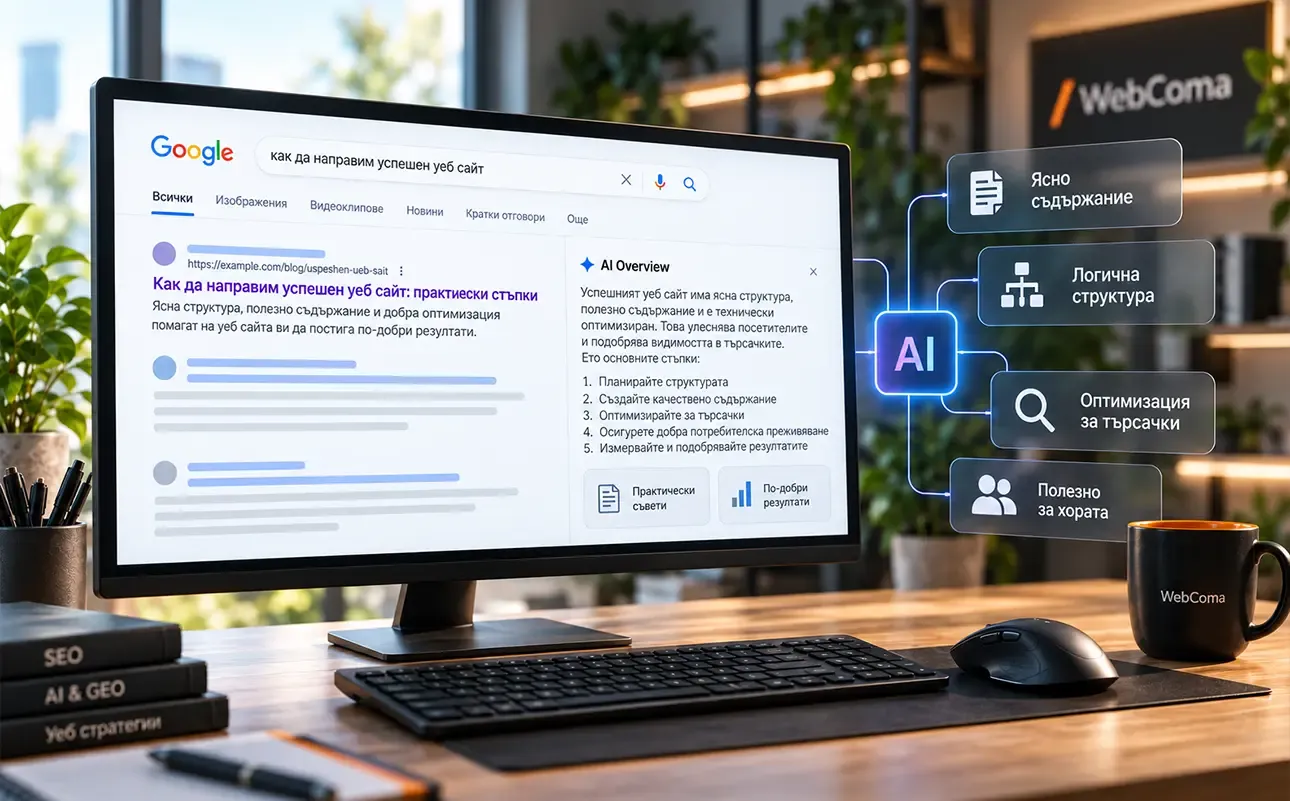

AIO / GEO content work makes sense when pages explain accurately what a business offers, whom it helps and under what conditions. Clarity helps readers and provides a reasonable foundation for search that includes generated answers. It does not guarantee that a particular platform will cite the website.
At WebComa, we use “AIO / GEO optimization” to describe work on content, structure and connections between topics in this context. It is not a separate set of secret rules shared by every AI system.
What Google says about AI Overviews and AI Mode
Google Search Central states that established SEO practices remain relevant to these features. Appearing in them does not require special optimization, a new AI text file or a separate schema.org type.
To be eligible as a supporting link, a page must be indexed and eligible to appear in Google Search with a snippet. Meeting these conditions does not guarantee crawling, indexing or display.
Google also describes how AI features may use several related searches when preparing an answer. This does not provide a ranking formula. Our practical conclusion is to cover the important questions around a topic with enough context, rather than repeat one key phrase.
What clear content means in practice
A service page should explain whom it is for, what it includes, what the work delivers and what falls outside its scope. An article should answer its own specific question.
Here is an example of the editorial difference:
- General: “We offer comprehensive solutions for your success.”
- Specific: “We connect the online store to the ERP system to exchange agreed product and stock data. Before starting, we check the available API and its limitations.”
The second is an illustrative statement, rather than a description of a completed project. It provides a concrete subject for discussion and defines the boundaries of the task.
Google’s guidance on helpful content emphasises content for people, reliability and clarity about who creates it. Authorship and real experience provide context, rather than decorative fields.

Where to start
1. Choose one important page
Start with a service or topic that people actually ask you about. Write down what a reader should understand after reading it. Do not add another article simply to have more content.
2. Give the answer before the details
The opening paragraph should explain the task or main conclusion. Follow it with conditions and examples. Use headings that describe what the section contains.
3. Separate facts from recommendations
For statements about another organisation’s system, provide an official source and check the date. For your own experience, explain the context. Do not turn an unconfirmed result into a promise.
4. Connect information when it helps
A link to a real project can show how an approach was applied. A related service can clarify the scope. Avoid repeating the same URL in every section.
5. Check the technical foundation
Establish whether the page is accessible to the relevant search system, whether important content can be read and whether structured data matches the visible text. This is part of website SEO work, rather than a substitute for useful content.
How to monitor the result
As checked on 30 September 2026, Google describes a Generative AI performance report in Search Console with data on impressions in AI Overviews and AI Mode. Report availability also depends on whether the website has received enough impressions in the supported features.
Bing describes AI Performance and additional metrics for citations, topics and changes over time. Its official explanation presents Citation Share as an observational metric, rather than a ranking system or a share of traffic.
Keep these measurements distinct. An impression, citation, visit and enquiry are different observations. Review the data alongside actual website use and check the scope of each report.
What we can improve and what we cannot promise
AIO / GEO optimization work addresses content clarity, information structure and verifiability. A concrete scope of edits and checks can be agreed.
Citations, a particular ranking or a lasting presence in AI answers cannot be promised. The external platform’s decisions remain outside the control of both the business and its provider. The useful outcome of an edit is therefore a more accurate, understandable page, even when no AI citation is observed.