



A website has a clear role in the business when you can say whom it serves, which task it makes easier and what happens after the visitor takes action. “Having an online presence” may be a start, but is not enough to decide what to build.
At WebComa, we see the website as part of the company’s work. We first clarify the need, then discuss structure, design and the technical foundation.
What do you want the new website to change?
“We want a new website” names a project without explaining its reason. Perhaps the current pages describe outdated services, customers send incomplete enquiries or important documents are hard to find. Identify the specific difficulty and the intended result.
Not every reason requires rebuilding from scratch. If the problem is limited to content or a particular action, assess whether changing the current website is enough. Where several goals compete, choose the main one and discuss the others in relation to it.
Whom should it help most?
Define the priority audience instead of planning for “everyone”. A prospective customer unfamiliar with a service has different questions from a partner looking for technical documentation. One website can serve both, but does not need to show them the same information in the same way.
For the important audience, clarify the situation in which they arrive, what they need to understand and a reasonable next step. That step is not always a purchase. Sometimes the task is to prepare for a conversation, check whether a service is suitable or find reliable information about the company.
Different businesses need different website roles
A corporate website may help prospective customers understand services and prepare for a conversation. A product catalogue may support selection and enquiries. A website for existing customers may provide documents and instructions.
For an internal workflow, the task may be managing requests and data through a custom web system. That is a different role from presenting the company publicly.
One project does not need to do all of this at once. Choose the main task and identify which additional functions actually support it.
In the Palisandar WooCommerce platform, the catalogue supports choosing product variants and preparing enquiries. This gives the website a specific role in the sales process, beyond presenting the company.
Check the whole journey, as well as the page
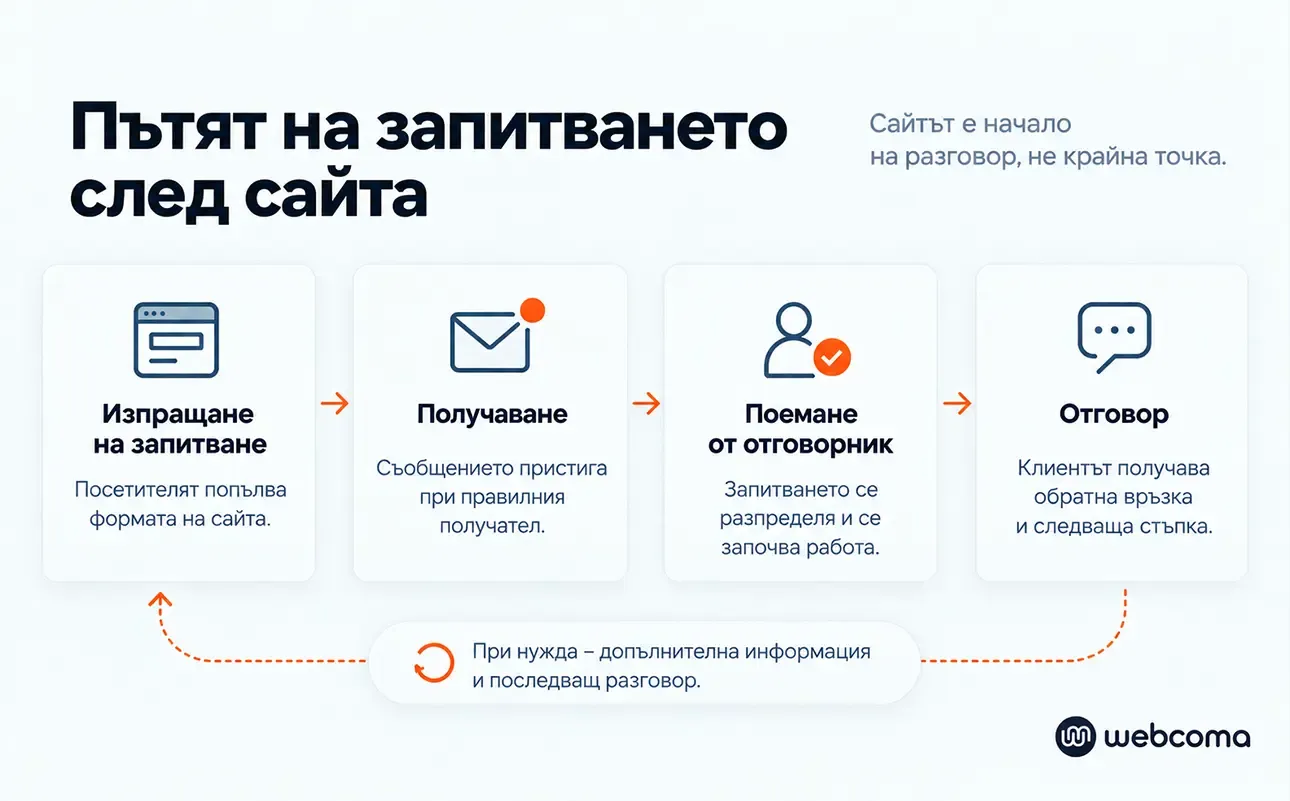
Consider an example business seeking enquiries about a particular service. Visitors need to understand whom the service is for, what it includes and what information to send. But the form is not the end of the process.
Who receives the enquiry? Is there enough information to reply? How does the visitor know the message has been sent? What should the employee do next?
These questions connect the page to everyday work. If no one is responsible for enquiries, changing the button colour will not fill that gap.
A clear role helps you decide what to add
Before adding a function, ask which task it will make easier. A blog makes sense when there are useful topics and someone to look after them. A customer area makes sense when it saves specific steps. Animation should support navigation where needed.
This does not mean giving up good visual design. It means assessing design alongside content and actions. Design can support the task when important information and the next step are easy to find.
Decide how you will know whether the website helps
Choose an observation related to its role. For enquiries, you might check whether they reach the right person and contain the necessary information. For a document library, whether customers find the correct file. For administration, whether employees can complete the required process.
Visit counts can be useful, but do not answer those questions on their own. Not every role is measured through a direct sale.
You can start with one sentence: “The website should help [specific people] to [a specific action], followed by [a clear next step].” If you cannot fill it in yet, that is a useful subject for the first project conversation.